9 Windy Street, Chipping, Preston, PR3 2GD
About 9 Windy Street
9 Windy Street is a two-bedroom end-of-terrace house in Chipping, Preston, Preston (PR3 2GD). It has a recorded floor area of 116 m² (around 1243 sq ft), construction records dating it to before 1900 and council tax band D. The latest certificate (March 2009) shows an F (score 31), near the bottom of the EPC scale. The recommended improvements would push it to E (score 48). Main heating runs on oil. The latest certificate is from March 2009, so improvements made since then won't be reflected.
At 116 m² the property is well over the postcode median (78 m² across 16 EPCs), placing it in the larger end of the local stock. Across 2009–2017, sale prices on this property compounded at 1.4% per year. Today's modelled estimate of £304,000 is 18.1% above the 2017 sale price. On a £-per-square-foot basis, the last sale (£207/sq ft) was about 37% above the typical sold price in the postcode. On the market in September 2017 and unlisted since — roughly 9 years.
What this property has
Inside
- Bedrooms2
- Bathrooms1
Everything you need to know about 9 Windy Street
The true value, the hidden risks and the full sale history, in one report.
Pick your report · from £14.99
One time fee only - money back guarantee
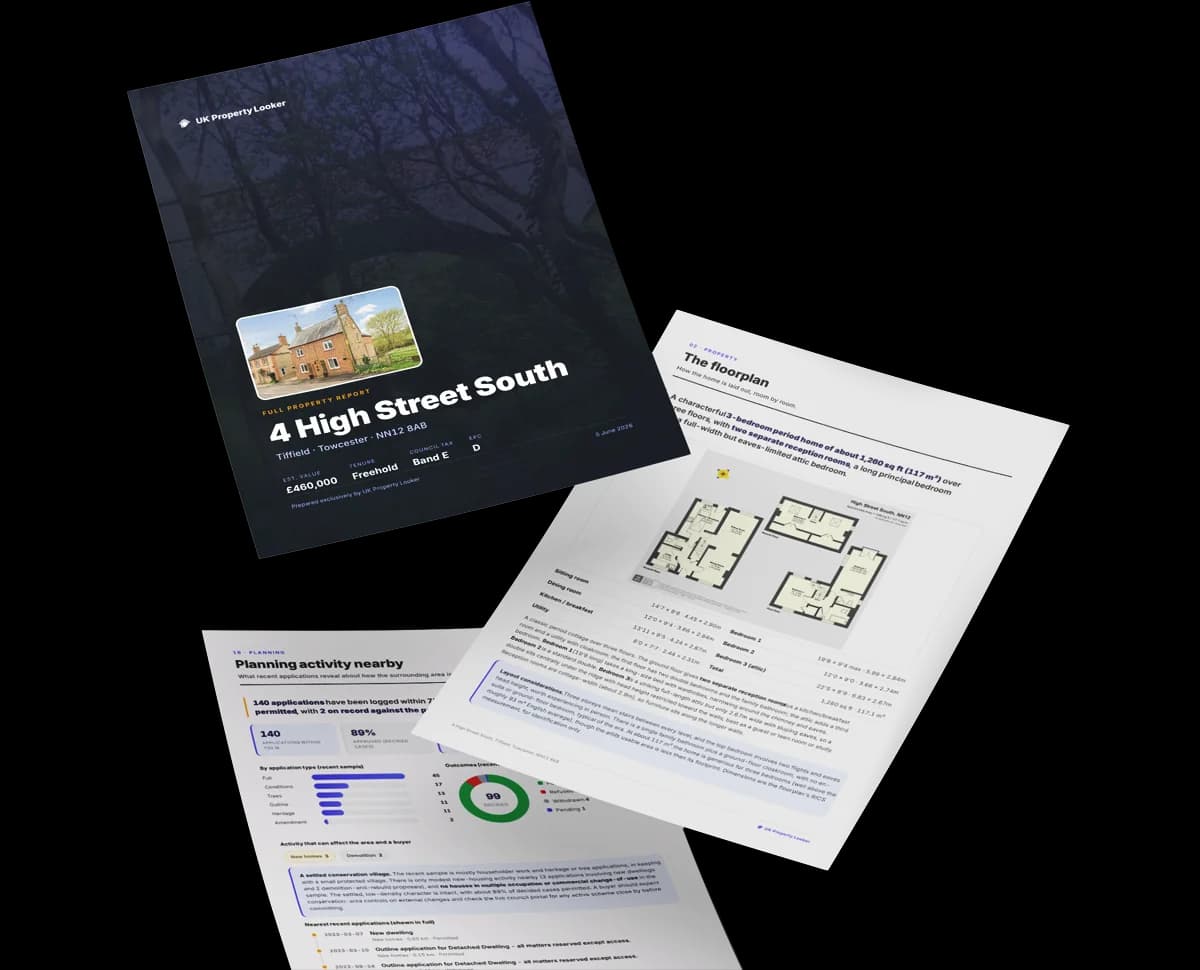
The data behind every report







Energy performance
9 Windy Street's carbon output runs well above what efficient homes in the postcode produce.
EPC Expired
This certificate is over 10 years old and is no longer valid.Expired 29 Mar 2019
EPC Rating
Certificate validity
Expired on 29 March 2019

Get a survey for this property
Level 3 Building Survey
Because the property was built before 1919 and has no mains gas supply, we believe a Level 3 building survey should be considered.
From £955 · Includes VAT
Planning history
9 Windy Street has no planning applications on record.
But the area is active
5 notable applications nearby — larger schemes and conversions that could reshape the street. The report maps them all.
Sales history & valuation
9 Windy Street valuation sits well clear of the typical sold price in this postcode.
£304,000
Modelled from EPC, postcode comparables and a sale-price growth of 1.4% per year over 8 years.
£257,500
Growth on file: 1.4% per year over 8 years.
Sales timeline
14 September 2017Most recent
£257,500
+12.0%over 8 years13 August 2009
£230,000
Median price across the last 5 sales in PR3 2GD: £150,000 (2025–2022).
Nearby sales in PR3 2GD
19 Windy Street, Chipping, Preston, PR3 2GD
Sold Oct 2025
£235,00010 Windy Street, Chipping, Preston, PR3 2GD
Sold Dec 2024
£150,0001 Windy Street, Chipping, Preston, PR3 2GD
Sold Mar 2024
£200,0005 Windy Street, Chipping, Preston, PR3 2GD
Sold Sept 2022
£150,00027 Windy Street, Chipping, Preston, PR3 2GD
Sold Nov 2021
£670,000
Versus other Windy Street homes
Floor Area for 9 Windy Street runs comfortably ahead of the street norm.
Price per m²
£2,229
Street avg £2,039
Floor Area
116 m²
Street avg 94 m²
Habitable Rooms
4 rooms
Street avg 4 rooms
CO₂ Emissions
12.0 t/year
Street avg 7.3 t/year
Everything you need to know about 9 Windy Street
The true value, the hidden risks and the full sale history, in one report.
Pick your report · from £14.99
One time fee only - money back guarantee
The data behind every report
Similar properties nearby
1 Camellia Street, Longridge
PR3 2FG
1 Blossom Court, Goosnargh
PR3 2AF
1 Bluebell Crescent, Longridge
PR3 2RQ
1 Beacon Drive, Goosnargh
PR3 2BA
1 Bleasdale Road, Whittingham
PR3 2AR
1 Chapel Brow, Longridge
PR3 2YD
1 Broad Meadow, Chipping
PR3 2GH
1 Black Moss Cottages, Chipping Road, Thornley
PR3 2TB
The neighbourhood at a glance
Daytime road noise here sits well below conversation level — a quiet pocket of the postcode.
Crime
221/mo
Falling year-on-year across the wider district.
Nearest stop
0.0 km
Sun Inn — bus stop.
Closest school
0.1 km
Brabins Endowed School. 2 schools nearby.
Go deeper on the local area
A Local Area report breaks down crime, transport links, schools and air quality in depth.
Road noise across the postcode

Daytime· 07:00 – 23:00
46.1dB

Night-time· 23:00 – 07:00
36.6dB