5 Ainspool Lane, Churchtown, Preston, PR3 0TA
About 5 Ainspool Lane
5 Ainspool Lane is a semi-detached house in Churchtown, Preston, Preston (PR3 0TA). It has a recorded floor area of 132 m² (around 1421 sq ft), construction records dating it to 1930-1949 and council tax band C. The latest certificate (May 2009) shows a D (score 67), on the cusp of jumping into the C band. The recommended improvements would push it to C (score 73). The latest certificate is from May 2009, so improvements made since then won't be reflected.
At 132 m² the property is well over the postcode median (93 m² across 6 EPCs), placing it in the larger end of the local stock. 2 planning records sit against the property, 1 approved, 1 refused. Past consents include an extension, meaningful when judging how the property has evolved. On the market in December 2016 and unlisted since — roughly 10 years. Across 2007–2016, sale prices on this property compounded at 2.8% per year. Today's modelled estimate of £359,000 is 28.2% above the 2016 sale price.
Everything you need to know about 5 Ainspool Lane
The true value, the hidden risks and the full sale history, in one report.
Pick your report · from £14.99
One time fee only - money back guarantee
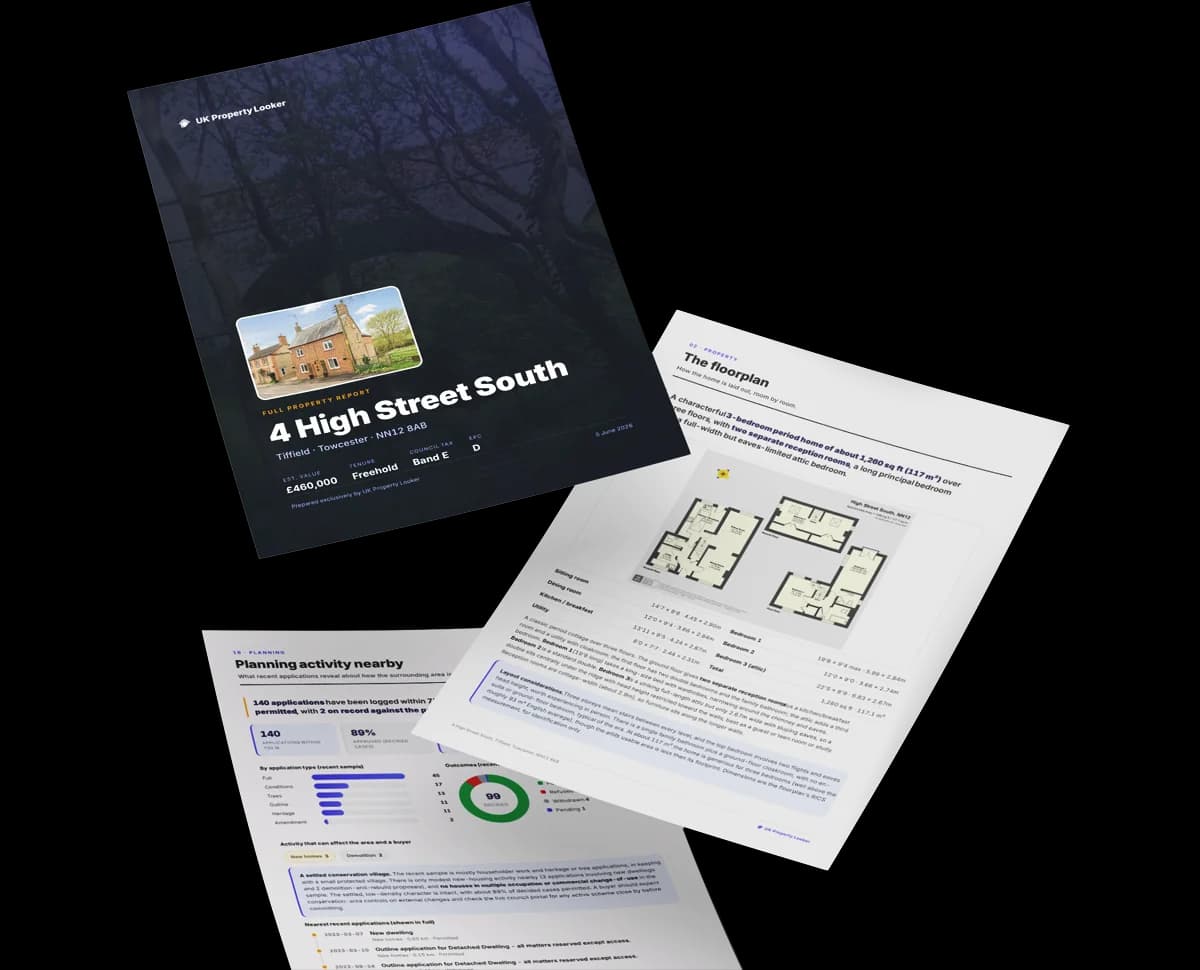
The data behind every report







Energy performance
5 Ainspool Lane's EPC is over a decade old — improvements since won't be reflected.
EPC Expired
This certificate is over 10 years old and is no longer valid.Expired 17 May 2019
EPC Rating
Certificate validity
Expired on 17 May 2019

Get a survey for this property
Level 2 HomeBuyer Report
We've checked 10 risk factors against the available data for this property and believe a Level 2 HomeBuyer Report could be a suitable option for you.
From £595 · Includes VAT
Planning history
2 applications on record at 5 Ainspool Lane, Churchtown, Preston, PR3 0TA
- Apr 2007ExtensionFullOutcome in report
Extension: Side and rear of property
Two storey side extension and single storey rear extension
- Documents
- 4 docs on file
- Reference
- 07/00254/FUL
- More recent applications — locked
- ExtensionJul 2007Decision
Unlock 5 Ainspool Lane, Churchtown, Preston, PR3 0TA's full planning history
You're seeing the shape of it. The report has the substance.
- Every decision — granted, refused or withdrawn (2 on record)
- All 2 applications on this property in full, plus 12 notable nearby
- The 9 documents, officer reports & conditions
- What the pattern means for extending or converting here
One time fee only - money back guarantee
Sales history & valuation
5 Ainspool Lane saw 3 transfers in just over a decade — high turnover for the postcode.
£359,000
Modelled from EPC, postcode comparables and a sale-price growth of 2.8% per year over 10 years.
£280,000
Growth on file: 2.8% per year over 10 years.
Sales timeline
9 December 2016Most recent
£280,000
+13.1%over 7 years6 November 2009
£247,500
+15.7%over 2 years26 January 2007
£214,000
Median price across the last 5 sales in PR3 0TA: £228,000 (2022–2014).
Nearby sales in PR3 0TA
15 Ainspool Lane, Churchtown, Preston, PR3 0TA
Sold May 2022
£230,00025 Ainspool Lane, Churchtown, Preston, PR3 0TA
Sold Dec 2020
£465,0009 Ainspool Lane, Churchtown, Preston, PR3 0TA
Sold Oct 2020
£228,00017 Ainspool Lane, Churchtown, Preston, PR3 0TA
Sold Apr 2019
£198,00023 Ainspool Lane, Churchtown, Preston, PR3 0TA
Sold Nov 2008
£330,000
Versus other Ainspool Lane homes
Price per m² for 5 Ainspool Lane lags the street by a wide margin.
Price per m²
£2,121
Street avg £2,745
Floor Area
132 m²
Street avg 118 m²
Habitable Rooms
6 rooms
Street avg 5 rooms
CO₂ Emissions
4.7 t/year
Street avg 4.9 t/year
Everything you need to know about 5 Ainspool Lane
The true value, the hidden risks and the full sale history, in one report.
Pick your report · from £14.99
One time fee only - money back guarantee
The data behind every report
Similar properties nearby
1 Allotment Lane, St Michaels
PR3 0TZ
1 Beacon Close, Bilsborrow
PR3 0QY
1 Blackthorn Avenue, Catterall
PR3 0NP
1 Bowland Gardens, Forton
PR3 0BG
1 Brock Road, Great Eccleston
PR3 0XD
1 Ballot Hill Crescent, Bilsborrow
PR3 0RX
1 Bakewell Close, Catterall
PR3 0DT
1 Bramble Court, Catterall
PR3 0NF
The neighbourhood at a glance
Daytime road noise here sits well below conversation level — a quiet pocket of the postcode.
Crime
221/mo
Falling year-on-year across the wider district.
Nearest stop
0.2 km
Horns Inn — bus stop.
Closest school
0.3 km
Kirkland and Catterall St Helen's Church of England Voluntary Aided Primary School. 5 schools nearby.
Go deeper on the local area
A Local Area report breaks down crime, transport links, schools and air quality in depth.
Road noise across the postcode

Daytime· 07:00 – 23:00
46.6dB

Night-time· 23:00 – 07:00
40.4dB